
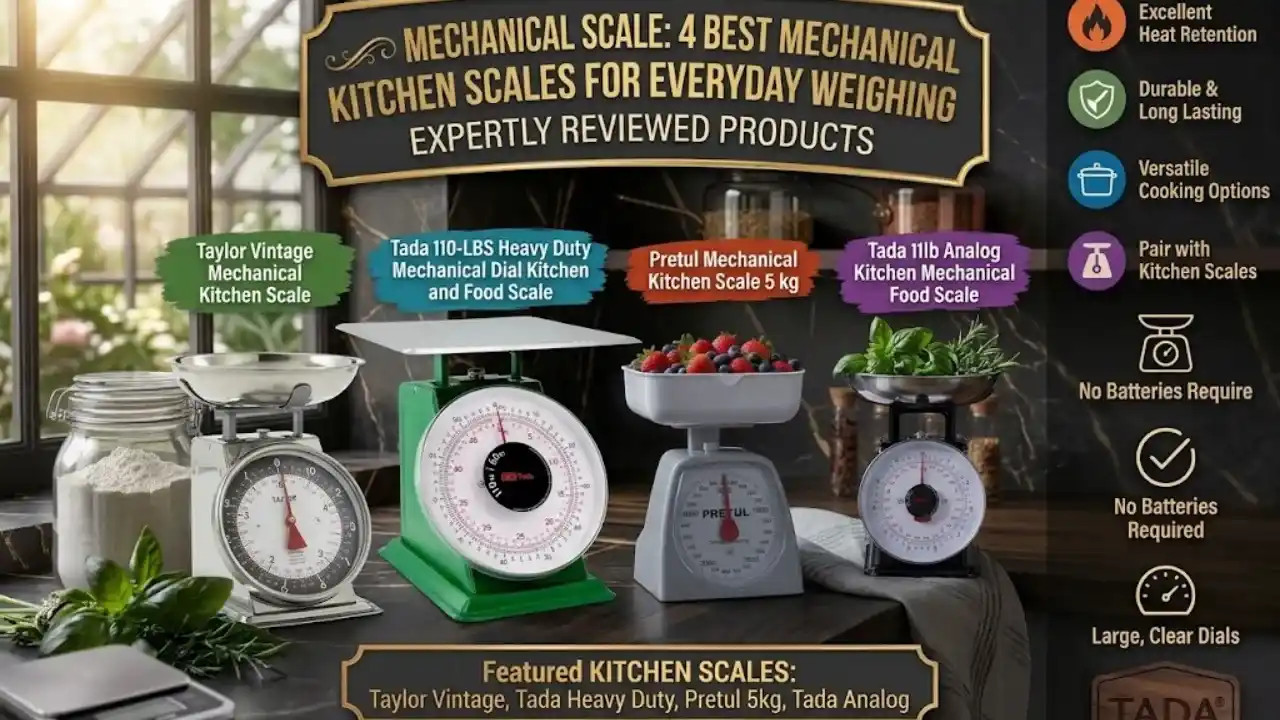
A mechanical scale requires no batteries or any charge, it is a simple method for weighing food and ingredients. We through some basic kitchen scales and four mechanical kitchen scales comparisons in this guide as we also breakdown a balance weighing scale, digital kitchen scales, and weigh other common use options.
Image to see the different types of analogue scales — other than mechanical — you can do a little thinking and miraculously find out which one you should be looking for .The most important feature to hunt in the market is not some premium type, but it always needs an answer.There is no compromise on even small measures.
Quick Comparison
| Product | Capacity | Main Feature | Best For |
| Taylor Vintage Mechanical Kitchen Scale | 11 lb / 5 kg | Removable bowl and tare | Baking & everyday cooking |
| Tada 110-LBS Heavy Duty Mechanical Dial Kitchen and Food Scale | 110 lb / 50 kg | Heavy-duty steel body | Large and heavy items |
| Pretul Mechanical Kitchen Scale 5 kg | 5 kg | Manual adjustment | Basic kitchen weighing |
| Tada 11lb Analog Kitchen Mechanical Food Scale | 11 lb / 5 kg | Battery-free spring design | Everyday cooking |
What Is a Mechanical Scale?
A mechanical scale incorporates spring or physical mechanism for measuring weight. There are no batteries, no electricity.
A mechanical scale can be used while weighing flour, meat and vegetables etc. In addition, if you want to avoid a digital display of all kinds, it is also an excellent option.
The balance weight scale works differently when we compare it to a mechanical dial model. An item to be weighed is compared in weight with a known weight (a balance) and most mechanical kitchen scales operate on a spring mechanism.
1. Taylor Vintage Mechanical Kitchen Scale
Taylor Vintage Mechanical Kitchen Scale Taylor; Type: Mechanical scale; The Purpose of this Product — Practical kitchen mechanical scale for baking, cooking and portion control Code that unlocks the secret to simple. It holds 11 lb for everyday kitchen needs.
Key Features
- Battery-free spring mechanism
- 11 lb / 5 kg capacity
- 1 oz / 50 g increments
- Pounds/ounces and kilograms/grams
- Removable weighing bowl
- Manual zero-adjust knob
- Dishwasher-safe bowl
Easy-to-Read Dial
The big dial is marked in pounds, ounces and kilograms and grams. This makes them easy to check when following recipes.
Removable Bowl
The bowl itself is removable to make it easier to fill and clean. It even turns to the base for easy storage.
Pros
- No batteries required
- 11 lb capacity
- Removable bowl
- Tare function
- Easy-to-read dial
Cons
- Big steps than most other digital scales
- Not very well suited for exact measurements

Best For
This mechanical scale is the most practical for regular cooking, baking and other general ingredient measuring.
Also read: Best Pre Seasoned Cast Iron Frying Pan: 4 Best Cast Iron Skillets
2. Tada 110-LBS Heavy Duty Mechanical Dial Kitchen and Food Scale
The Tada 110-LBS Heavy Duty Mechanical Dial Kitchen and Food Scale are meant for much heavier items. Its respective capacity of 110 lbs is what distinguishes it from any standard home kitchen scales.
Heavy-Duty Construction
It comes with an anti-rust steel body and a shatter-proof lens. In addition, its platform is made of stainless steel and does not retain contamination.
Large Capacity
This can reach 110 lb or 50 kg. Measures in 8 oz or 200 g intervals. For big foods, farm produce, meat, grain, feed, parcels and baggage.
Easy-to-Read Dial
This is a much more traditional scale with an angled dial, big digits and the option for kilograms and pounds. The large face allows the readings to be more easily seen.
Pros
- 110 lb / 50 kg capacity
- Heavy-duty steel body
- Large platform
- Easy-to-read dial
- No batteries required
Cons
- Large measurement increments
- More suited to lumps than precision baking

Best For
This is a mechanical scale suitable for large food items, produce, packages and other high weight weighing.
3. Pretul Mechanical Kitchen Scale 5 kg
The Pretul Mechanical Kitchen Scale is a simple, mechanical scale that can weigh up to 5 kg. This is a simple design that makes it ideal for normal kitchen weighing.
Simple Manual Design
The scale is housed in a plastic housing and the adjustment mechanism is hydraulic. The indicator is made to be easily readable.
Detachable Tray
The removable tray ensures that you have a handy spot to place ingredients before weighing them up.
Main Features
- 5 kg capacity
- Plastic housing
- Manual adjustment
- Easy-to-read indicator
- Detachable tray
- Gram measurement
Pros
- Simple design
- Manual operation
- Detachable tray
- No battery required
- Easy to use
Cons
- Fewer features than digital scales
- Not intended for ultra-fine measurements

Best For
If you want a simpler, manual design in your kitchen then this mechanical scale is ideal for basic weighing.
4. Tada 11lb Analog Kitchen Mechanical Food Scale
The Tada Kitchen Mechanical Food Scale has an old school dial and removable stainless steel bowl — 11lb This is yet another handy mechanical scale for daily cooking.
Battery-Free Operation
What makes this scale its own, is the fact that it relies on mechanical spring technology – so no batteries or electricity.
Stainless Steel Bowl
The bowl is a stainless steel itself which can be removed for easy cleaning. Provides you with a conveniently location to weigh out ingredients
Capacity and Precision
The scale goes up to 11 lb or for 5 kg. It is read in 1 oz or increments of 20 grams.
Pros
- No batteries
- Removable bowl
- Stainless steel construction
- Easy-to-read dial
- 11 lb / 5 kg capacity
Cons
- One can not use this for less data measurements.
- Analog readings need to be taken by looking at the dial

Best For
This mechanical scale is more suitable for home cooking, food preparation, and consumers looking for a traditional analog appearance.
Mechanical scale vs digital kitchen scale
A mechanical type uses a spring and dial and the digital kitchen scale uses electronic sensors and an LCD.
Digital scales typically have a lower minimum weight increment available, while there is no need for batteries with a mechanical scale.
For electronic measurement options, consider something like the Escali Primo Digital Kitchen Scale.
Another name for small portable scales is weighing scale pocket. Usually these are made to provides functionality for small weighting and not something which you use on work table in your kitchen.
What Is Three Types of Scales?
There are three main types of scale, they are:
Mechanical – traditionally utilize springs or similar methods of physics. They are digital scales, they use electronic sensors to provide a digital reading.
Balance scales – compare an object with standard masses. Some familiar ones for a balance scale is using weights on a scale.
How do you read a mechanical scales?
Never worry that the needle is busy spinning around yet waiting for data up until October 2023.
Observe the pointer and compare it with the points that are marked with a number. If the scale displays both amounts in pounds and kilograms, choose an appropriate unit as per your recipe.
Ensure that the polygram is properly set to zero before weighing.
Also read: 5 Backpacking Food Recipes: Easy, Filling, and Practical Meal Ideas for the Trail
What Are The 4 Types of Weight Scale?
Four common categories include:
- Mechanical scales
- Digital scales
- Balance scales
- Platform or heavy-duty scales
- works best for you will depend on what you’re weighing and how accurate you need to be with the weight.
Common Kitchen Scale Terms To Understand
While browsing kitchen scales, you will observe terms such as scales weights, balance scales and digital food scale.
Balance weighing scale — A standard weighing method when you want a traditional approach to measuring. A balance weight scale compares an object against a set of known weights.
Modern kitchens benefit from a balance digital scale/standard digital food scale for a readable electronic display and practical measurements. For a small hand-held option you would use search terms like weighing scale pocket.
Those are the keywords that would be used to search taylor products, taylor scale manual when individuals need information on how it works or how it should be adjusted.
Final Thoughts
A mechanical scale is a low-tech way to weigh food in the kitchen but requires no batteries. Choose whether you need a bigger bowl, different measurement increments, etc. as these four models have various capacities and design solutions.
FAQs
Q1. Is a mechanical scale good for a kitchen?
Yes. A mechanical scale can be useful for baking, cooking, meal preparation, and portion control.
Q2. Do mechanical kitchen scales need batteries?
No. Mechanical models that use spring mechanisms work without batteries or electricity.
Q3. Is a mechanical scale accurate?
A mechanical scale can provide useful weight readings, but its measurement increments may be larger than those of a digital kitchen scale.
Q4. What is the difference between a mechanical and digital scale?
A mechanical scale uses a physical mechanism and dial, while a digital scale uses electronic sensors and shows the weight on a digital display.
Q5. Can I use a mechanical scale for baking?
Yes. A mechanical scale can be used for measuring ingredients such as flour and sugar, depending on its capacity and measurement increments.
Q6. What can I weigh with a mechanical kitchen scale?
You can use a mechanical scale for many everyday ingredients, including flour, vegetables, meat, and other food items within the scale’s weight capacity.
Q7. Does a mechanical scale need to be zeroed?
Yes. Check the dial before weighing and use the adjustment control when needed so the scale starts at zero.


1 Comment
[…] Also read: Mechanical Scale: 4 Best Mechanical Kitchen Scales for Everyday Weighing […]